
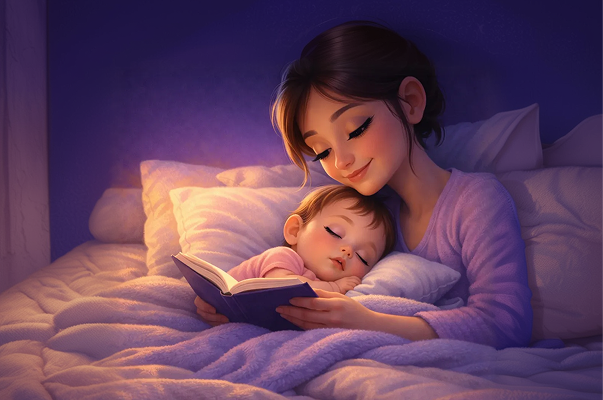
If you've ever noticed a fussy baby settle the moment you start talking—or a wired seven-year-old finally grow quiet when you begin narrating a favorite story—you've already seen the power of a familiar voice in action.
A mother's voice can be deeply comforting, but this connection is not limited to mothers. A father, grandparent, adoptive parent, foster parent, or another trusted caregiver can also become an important source of safety and reassurance. When someone speaks with warmth, patience, and love, their voice can become part of a child's calming bedtime routine.
A calm, familiar voice can serve as a reassuring cue at bedtime, helping a child feel safe, connected, and ready to rest.
Babies Recognize Your Voice Before They're Even Born
By the third trimester, a baby's hearing is developed enough to pick up the rhythm and pitch of their parents' voices through the womb. Researchers have found that newborns can distinguish their mother's voice from a stranger's within days of birth, and will change their sucking pattern to "choose" hearing it.
That recognition doesn't fade after birth. It becomes one of the core signals a child's nervous system uses to know: I am safe. I am home.
As children grow, other familiar voices can become part of that circle of safety, too. The voice of a father, grandparent, sibling, or trusted caregiver can carry its own history of cuddles, songs, conversations, and comfort. Over time, the sound of that voice becomes connected with the feeling of being cared for.
That's very different from a screen or a stranger's voice on a recording. A screen adds light and stimulation right when a child's brain is supposed to be winding down. A familiar voice does the opposite—it's a signal to relax.
The Science of a Calming Voice
A few things happen physiologically when a child hears a parent's voice at bedtime:
- Cortisol drops. Hearing a caregiver's voice, even over a phone call, lowers the stress hormone faster than text-based reassurance or silence.
- Heart rate steadies. The rhythm and pacing of a familiar voice, especially at a slow, low-pitched "bedtime cadence," has a measurable calming effect on heart rate variability.
- Oxytocin rises. Warm vocal contact—singing, reading, or just talking softly—triggers the same bonding hormone activated by touch.
Put simply: it's not just the story that helps children sleep. It's who is telling it.
A parent's voice carries more than words. It carries rhythm, emotion, familiarity, and connection. Children recognize the pauses, expressions, and little variations that belong to the people they love. Even a story they have heard many times can feel special when it is told in a familiar voice.
Why Bedtime Stories Help Children Relax
The benefits of reading before bed go far beyond learning new words. Bedtime stories for children create a gentle bridge between the activity of the day and the quiet of sleep.
Stories give children something peaceful to focus on. Instead of replaying the day's worries or resisting bedtime, they can follow a character through an enchanted forest, sail across a moonlit sea, or imagine a friendly animal curling up beneath the stars.
This shift into imagination helps bedtime feel less like an ending and more like an invitation. The body becomes still while the mind enters a softer, slower kind of activity—one filled with images, possibilities, and dreams.
Reading together can also support:
- Language and vocabulary development
- Listening and concentration skills
- Creativity and imagination
- Emotional understanding
- Parent-child connection
- A predictable and calming bedtime routine
The rhythm of storytelling matters, too. Stories naturally slow conversation down. Sentences have a beginning, middle, and end. Pages turn at an unhurried pace. Familiar stories offer repetition and predictability, which can be especially reassuring to children at bedtime.
Bedtime Stories Matter at Every Age
Bedtime stories are often associated with babies and preschoolers, but children do not suddenly outgrow the comfort of a familiar voice.
For babies, the meaning of every word matters less than the sound, rhythm, and warmth of the person speaking. A baby may relax while listening to a picture book, a lullaby, or even a parent gently describing the day.
Toddlers and preschoolers enjoy repetition. They may request the same story night after night because knowing what comes next creates a sense of security and control.
School-age children can enter more detailed worlds of adventure, humor, and imagination. Reading together gives them space to ask questions, talk about feelings, and reconnect with a caregiver after a busy day.
Even older children and teenagers may find comfort in being read to, listening to an audiobook in a parent's voice, or sharing a quiet conversation before sleep. The stories may change as children grow, but the need for connection does not disappear.
At every age, a familiar voice can help create a small sanctuary between the demands of the day and the quiet of the night.
Why This Matters More as Screens Take Over Bedtime
Pediatric sleep specialists have been raising concerns for years about screens creeping into the wind-down window before bed. Blue light suppresses melatonin production, and fast-cut, algorithm-driven content keeps a child's brain in an alert, stimulated state—the opposite of what bedtime needs.
A voice-led routine sidesteps both problems: no light, no algorithm, just a steady, familiar presence.
Replacing even a few minutes of bedtime screen use with storytelling can change the atmosphere of the room. The goal is not to create a complicated or perfect routine. It is simply to offer children a predictable moment when the world becomes quieter and someone they trust is close by.
How to Create a Calming Bedtime Routine
You don't need special training or a perfect storytelling voice. Children are comforted by your voice—the one they already associate with love and home.
Try these simple ideas:
Slow down your voice
During the last 20 minutes before bed, speak a little more slowly and softly, even during ordinary conversation. A steady bedtime cadence can help signal that the active part of the day is ending.
Read a familiar story
Let your child choose a favorite book, even if you have read it dozens of times. Repetition can be calming because children know what to expect.
Tell stories in your own words
You do not always need a book. Retell a family memory, invent a gentle adventure, or describe an imaginary journey together. A story created in the moment can feel especially personal.
Invite your child into the story
Ask simple, soothing questions: What color is the dragon? Where should the boat sail next? What do you think the little fox dreams about? This turns storytelling into a shared journey through relaxation and imagination.
Use the same closing words
Say the same sign-off each night. Ours at Voice of Mama is, "Sleep tight, don't let the bedbugs bite." A consistent closing phrase can become its own sleep cue over time.
Preserve a familiar voice when you are away
If you travel, work nights, live in another home, or cannot always be there at bedtime, record a lullaby, story, or simple "Goodnight, I love you." Hearing a loved one's voice can help preserve a sense of familiarity and connection across distance.
The Story Matters—but the Voice Makes It Home
Bedtime stories for children do not need elaborate plots, expensive books, or professional narration. What matters most is the feeling created around them: safety, connection, consistency, and love.
That idea inspired Voice of Mama—to help families create personalized bedtime stories, lullabies, and sleep sounds in a parent's or loved one's familiar voice for the nights when they cannot be in the room.
The tools around bedtime will keep changing. What remains constant, night after night, is the comfort of hearing someone who loves you.
Long before children understand every word, they understand warmth. Long after they can read independently, they may still remember the voice that carried them gently into dreamland.